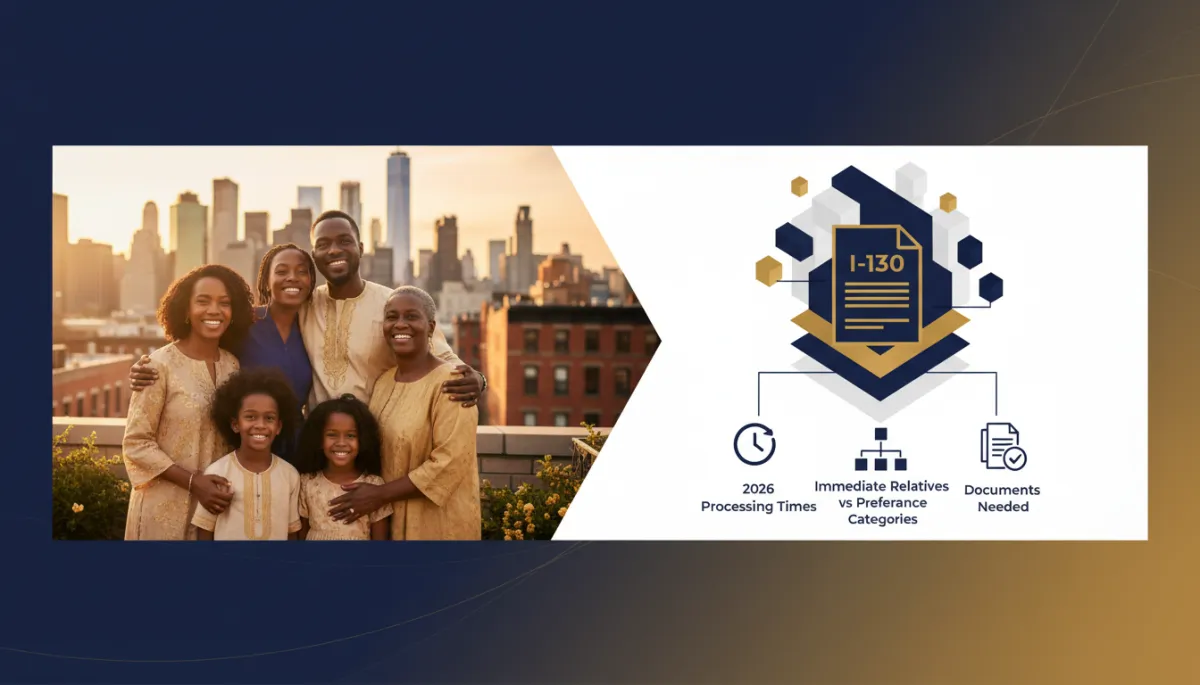
How to Sponsor a Family Member for a Green Card in 2026: I-130 Document Guide (Brooklyn)
Immigration, Family Sponsorship, Brooklyn NY
How to Sponsor a Family Member for a Green Card in 2026: I-130 Document Guide (Brooklyn)
SAIDOU BA & FAMILY LLC provides immigrant assistance services. We are NOT licensed attorneys and cannot provide legal advice. For a free legal referral, call the Office for New Americans Hotline: 1-800-566-7636.
Sponsoring a loved one for a green card is a big step, especially if you are balancing work, family, and community life here in Brooklyn. For many West African and Guinean families, the Form I-130 petition 2026 is the first official step to bring a spouse, child, or parent to live permanently in the United States. This guide is designed to walk you through the basics in clear, friendly language so you can feel more confident before you file.
Who Can File Form I-130 in 2026?
According to U.S. Citizenship and Immigration Services (USCIS), Form I-130, Petition for Alien Relative, is used to prove that a valid family relationship exists between you (the petitioner) and your relative (the beneficiary). You can always review the official instructions at uscis.gov/i-130 for the most current details.
U.S. citizens may file an I-130 for their spouse, unmarried or married children, parents, and brothers or sisters (see USCIS Form I-130 page at uscis.gov).
Lawful permanent residents (green card holders) may file for their spouse and unmarried children only (per USCIS guidance on Form I-130).
To file, you must live in the United States or have a qualifying address abroad, and you must provide proof of your own status as a U.S. citizen or permanent resident. Many families in Brooklyn use family sponsorship Brooklyn NY services to help gather and organize these documents before submitting to USCIS.
Immediate Relatives vs. Family Preference Categories
Not all family relationships are treated the same under U.S. immigration law. USCIS explains on uscis.gov that there are two main groups for family-based immigration: immediate relatives and family preference categories. Understanding this difference can help you set realistic expectations for your loved one’s wait time.
Immediate relatives of U.S. citizens include: spouse of a U.S. citizen, unmarried child under 21 of a U.S. citizen, and parent of a U.S. citizen who is at least 21. There is no annual visa limit for this group, so once the I-130 is approved and the rest of the process is complete, they can usually move forward more quickly.
Family preference categories cover other relationships, such as adult children of U.S. citizens, siblings of U.S. citizens, and spouses and unmarried children of permanent residents. These categories are subject to yearly visa limits, which often lead to long waiting lines shown in the Department of State Visa Bulletin.
For many West African and Guinean families in Brooklyn, this means a U.S. citizen sponsoring a spouse or young child may move faster than a green card holder sponsoring an adult son or daughter. When planning your sponsor family member green card journey, it is important to know which category your relative falls into.
Documents Typically Needed for an I-130 Petition
USCIS lists required evidence in the official I-130 instructions on uscis.gov. While every case is different, most Brooklyn families should expect to prepare the following types of documents:
Proof of your status: U.S. passport, naturalization certificate, or green card (front and back), depending on whether you are a citizen or lawful permanent resident.
Proof of the family relationship: marriage certificate for a spouse; birth certificates showing parent–child relationships; adoption decrees when applicable.
Passport-style photos: usually one or two photos of the petitioner and beneficiary, following USCIS photo rules.
Translations: any document not in English must include a full English translation with the translator’s certification, as required by USCIS.
Families from Guinea and other West African countries sometimes face challenges obtaining older birth or marriage records. While we cannot give legal advice, an immigration assistance service in Brooklyn can help you carefully follow the document list from uscis.gov and organize what you do have before you consult with a licensed attorney, if needed.
Careful document preparation can help avoid delays or requests for more evidence.
2026 I-130 Processing Times and the USCIS Backlog
USCIS processing times change often. The most accurate way to check current estimates is the official USCIS “Check Case Processing Times” tool at uscis.gov. As of 2026, national data show a record USCIS backlog of more than 12 million pending cases across many form types, which affects family immigration Brooklyn applicants as well.
For Form I-130, many U.S. citizen petitions are estimated around a year or a little longer, but lawful permanent resident sponsors may see waits of up to 35 months, depending on the service center and category. Immediate relatives of U.S. citizens are usually processed faster because they are not limited by annual visa caps, while preference category relatives may wait much longer even after I-130 approval because of visa number limits.
📌 Key Reminder: Always confirm current I-130 times directly on the USCIS website, as only uscis.gov provides official processing estimates.
What Happens After Your I-130 Is Approved?
Approval of the I-130 does not give your relative a green card by itself. USCIS explains that approval only confirms the family relationship. The next steps depend on whether your relative is inside or outside the United States and whether a visa number is available for their category.
If your relative is abroad: The case is usually sent to the National Visa Center (NVC) and then to a U.S. embassy or consulate for consular processing. Your relative will complete more forms, submit civil documents, and attend an interview before receiving an immigrant visa.
If your relative is in the U.S. and eligible: They may be able to apply for adjustment of status using Form I-485 when a visa is available, as explained on uscis.gov. This is a separate process with its own fees, forms, and processing time.
Because the overall backlog is so large, it is important to keep copies of everything you send, track your receipt numbers, and regularly check case status online at uscis.gov. Many families in Brooklyn choose a trusted immigration assistance service to help with forms and translations while also consulting an attorney for legal advice when needed.
Getting Community-Based Help in Brooklyn
If you are part of the West African or Guinean community in Brooklyn, you do not have to face the I-130 process alone. A local service familiar with family immigration Brooklyn issues can help you read USCIS instructions, organize documents, and prepare mailing packets, while always reminding you that only a licensed attorney can give legal advice or represent you in court.
SAIDOU BA & FAMILY LLC is Brooklyn's trusted immigration document assistance service. We are proud to serve our West African, Guinean, and broader immigrant community with care and dedication. Call us today at 866-860-4446 or visit immigrationservicessaidou.com